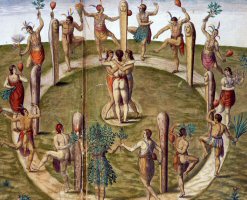
 Communal gatherings for dance, feasting and religious ceremony were an important part of village life. Seasonal gatherings brought villagers from many different towns together for ceremonial dancing and feasting. Dances, such as the one depicted, were held after sunset to avoid the heat. The dance circle, with its face-carved poles, related to Native cosmology and worldview. Harriott, Thomas. A briefe and true report of the new found land of Virginia, with engravings after John White. Published by Theodore de Bry. Frankfurt-am-Main, 1590. Courtesy The Mariners' Museum, Newport News, VA.
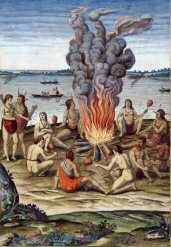 Large bonfires were lit as a part of religious ceremonies and communal celebrations. Villagers seated about his fire are shaking rattles made of dried gourds filled with small stones. A briefe and true report of the new found land of Virginia, with engravings after John White. Published by Theodore de Bry. Frankfurt-am-Main, 1590. Courtesy The Mariners' Museum, Newport News, VA.
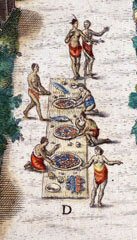 Special feasts were arranged by leadership figures of a village, a clan or a family unit to suit a particular occasion. Seating at feasts was arranged by sex, class, and political stature. Harriott, Thomas. A briefe and true report of the new found land of Virginia, with engravings after John White. Published by Theodore de Bry. Frankfurt-am-Main, 1590. Courtesy The Mariners' Museum, Newport News, VA.
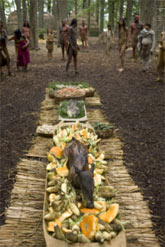 Choice foods were stored and saved for these special occasions. Feasts provided a town with an opportunity to demonstrate its generosity and prestige. Out of season foods were considered especially lavish, and thus prestigious. Photo © 2005 Merie Wallace, SMPSP / New Line Productions.
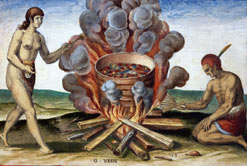 Large vessels provide evidence of feasting because they were necessary to produce large quantities of food. Stews and soups were made from a diverse variety of vegetables, meats, and seafood. Archeological evidence indicates that gatherings for feasting may have been more prevalent among the Chickahominies than other groups in the region. Harriott, Thomas. A briefe and true report of the new found land of Virginia, with engravings after John White. Published by Theodore de Bry. Frankfurt-am-Main,1590. Courtesy The Mariners' Museum, Newport News, VA.
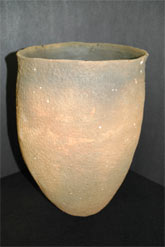 This large ceramic vessel found at a Chickahominy site provides evidence of feasting events associated with ritual activities. Thomas Hariott observed that Native women could make pots so large and fine that an English potter working with a potter’s wheel could do no better. He also observed that the pots could be moved about as easily as brass kettles. Photo courtesy of Dept. of Anthropology, College of William & Mary.
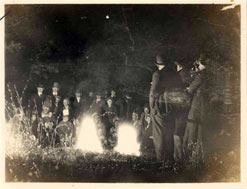 Anthropologist Frank Speck photographed this Christmas Eve bonfire gathering of the Pamunkies in the 1920s. Three hundred years after the settlement at Jamestown seasonal gatherings for ceremonial purposes remained an important part of Native life, but reflected adherence to Christianity rather than the traditional Native religion. Photo courtesy Charles City County Center for Local History.
next Education