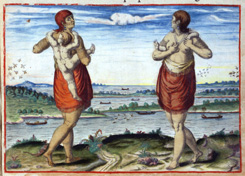
 Infants and young children enjoyed close physical contact with their mothers and other relatives. Example provided the chief means of education. Children modeled their own behavior after adult role models. In this way they learned how to play appropriate roles, master life skills and behave according to community norms. Harriott, Thomas. A briefe and true report of the new found land of Virginia, with engravings after John White. Published by Theodore de Bry. Frankfurt-am-Main,1590. Courtesy Mariners' Museum, Newport News, VA.
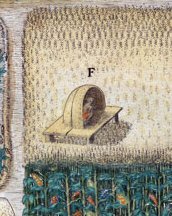 Indian children learned occupations by practicing them alongside their parents. Women directed children in weeding gardens and harvesting crops. Fathers and uncles trained young boys in archery, a skill that could be practiced from a scarecrow hut, while also protecting a garden from crows and other scavengers. Harriott, Thomas. A briefe and true report of the new found land of Virginia, with engravings after John White. Published by Theodore de Bry. Frankfurt-am-Main,1590. Courtesy The Mariners' Museum, Newport News, VA.
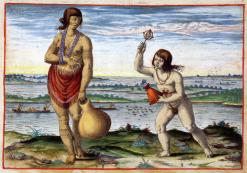 A girl followed her mother's lead in domestic tasks such as gathering food, harvesting crops, preparing food and making garments. The child in this engraving is shown with a doll and rattle given to her by an Englishman. Harriott, Thomas. A briefe and true report of the new found land of Virginia, with engravings after John White. Published by Theodore de Bry. Frankfurt-am-Main,1590. Courtesy The Mariners' Museum, Newport News, VA.
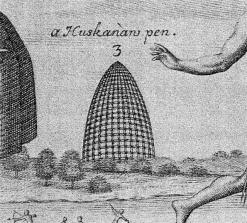 Boys entered into manhood through a rite of passage called the huskanaw. The rite of passage involved a ceremonial death and rebirth. Hallucinogens, physical torment and confinement in a huskanaw pen were employed to transform initiates from boys into men. Initiates were released from the pen when they no longer showed signs of their former boyhood. Griblin engraving for Robert Beverly, The History and Present State of Virginia, (London 1705).
 English culture viewed the practice of "fostering out" children to higher status families to be a valuable way for children to improve their prospects in life. This view, coupled with the desire to bring Christianity to the "infidels," drove colonial attempts to take Indian children from their parents and to educate them in European values and religion.
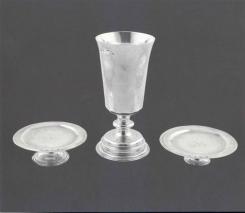
  Native people were very reluctant to give up their children to be educated because they did not share these values. The communion silver pictured here is from St. Mary's Church established at Southampton Hundred before 1622. The Hundred took in a number of children from local tribes. This communion silver is the oldest in continuous use in North America and the most spectacular European artifact originating in Charles City County from this era. Photo courtesy Virginia Museum of Fine Arts.
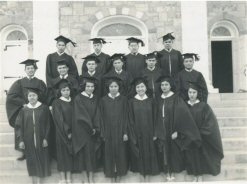 Three
hundred and fifty years after the first English attempts to Christianize Indians
a majority of Virginia Indians had become members of Christian denominations.
Six members of the Chickahominy Tribe appear in this 1950 graduation photo
from Bacone College, a Baptist affiliated institution in Oklahoma. Approximately
50 students from Charles City attended school at Bacone during a time when
Virginia schools were segregated and the local Indian school did not extend
to high school. Photo courtesy Bacone College.
Three
hundred and fifty years after the first English attempts to Christianize Indians
a majority of Virginia Indians had become members of Christian denominations.
Six members of the Chickahominy Tribe appear in this 1950 graduation photo
from Bacone College, a Baptist affiliated institution in Oklahoma. Approximately
50 students from Charles City attended school at Bacone during a time when
Virginia schools were segregated and the local Indian school did not extend
to high school. Photo courtesy Bacone College.
next Decorative Arts