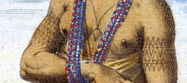
 Native women of the Mid-Atlantic were tattooed according to customs of the
 local community. Tattoos were probably applied to post-pubescent women, much as they are today, by piercing the skin with a sharp tool and rubbing pigment into the puncture.
Early English observers recorded seeing tattoos of animals, such as snakes, tortoises, and lizards, but tattoos most commonly depicted geometric designs like those used on ceramics. Harriott, Thomas. A briefe and true report of the new found land of Virginia, with engravings after John White. Published by Theodore de Bry. Frankfurt-am-Main,1590. Courtesy The Mariners' Museum, Newport News, VA.
local community. Tattoos were probably applied to post-pubescent women, much as they are today, by piercing the skin with a sharp tool and rubbing pigment into the puncture.
Early English observers recorded seeing tattoos of animals, such as snakes, tortoises, and lizards, but tattoos most commonly depicted geometric designs like those used on ceramics. Harriott, Thomas. A briefe and true report of the new found land of Virginia, with engravings after John White. Published by Theodore de Bry. Frankfurt-am-Main,1590. Courtesy The Mariners' Museum, Newport News, VA.
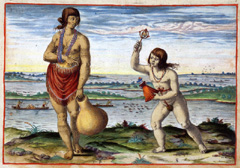 The published description for this engraving says of the Native women “their foreheads, cheeks, chynne, armes, and leggs are pounced (tattooed). About their neck they wear a chaine, either pricked or paynted.” While tattooing appears to have been common among women, men were described more commonly as using body paint. Harriott, Thomas. A briefe and true report of the new found land of Virginia, with engravings after John White. Published by Theodore de Bry. Frankfurt-am-Main,1590. Courtesy The Mariners' Museum, Newport News, VA.
Women styled their hair in accordance with social position. Young, prepubescent girls wore their hair closely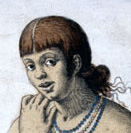 cropped with a long braid in the rear. Unmarried women appear to have worn their hair either with a double ridge of bangs above the forehead and the remainder trussed up in a knot behind or cut short above the shoulders. Married women cut bangs, but wore their hair long either flowing over their shoulders, in a braid or tied. Harriott, Thomas. A briefe and true report of the new found land of Virginia, with engravings after John White. Published by Theodore de Bry. Frankfurt-am-Main,1590. Courtesy The Mariners' Museum, Newport News, VA.
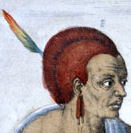
Male hair styles reflected religious beliefs bestowed by Okeus as proper for ‘real or true’ men. One side was shaved close, a cocks comb or mohawk stood in the middle, and a long braid or knot was tied on the opposite side. Harriott, Thomas. A briefe and true report of the new found land of Virginia, with engravings after John White. Published by Theodore de Bry. Frankfurt-am-Main,1590. Courtesy The Mariners' Museum, Newport News, VA.
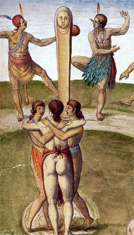
Virginia Native people carved wood for religious or decorative purposes. Period images and writings indicate the carvings represented human forms and deities. One writing identifies wooden sentinels standing outside a temple along the Chickahominy River. These sentinels might have represented a giant man, a serpent, a wolf or a bear. Harriott, Thomas. A briefe and true report of the new found land of Virginia, with engravings after John White. Published by Theodore de Bry. Frankfurt-am-Main,1590. Courtesy The Mariners' Museum, Newport News, VA.
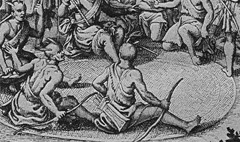 Woven basketry and matting incorporated a variety of designs, like the one
shown in this engraving. Spit cane, cattails, and hardwoods (like ash) were
woven into complex patterns. Dyes made from walnuts and bloodroot produced
multi-colored decorations. Hamor, Ralph. Dreyzehente Schiffart Darinnen Ein
Warhafftiger und Grundtlicher Bericht 1620.
Woven basketry and matting incorporated a variety of designs, like the one
shown in this engraving. Spit cane, cattails, and hardwoods (like ash) were
woven into complex patterns. Dyes made from walnuts and bloodroot produced
multi-colored decorations. Hamor, Ralph. Dreyzehente Schiffart Darinnen Ein
Warhafftiger und Grundtlicher Bericht 1620.
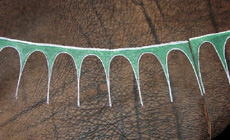
Patterns were painted and embroidered onto leather garments and prestige goods. Here, too, designs may have mimicked those found in tattoos, pipes, and ceramics. Photo courtesy of Buck Woodard.
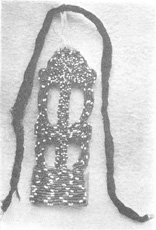
European traders brought glass beads that delighted the Native people. Since that time embroidery with glass beads has been a central element of Native decoration. This beaded neck ware, belonging to Chickahominy Chief Ozias Westmore Adkins, was photographed by anthropologist Frank Speck in the 1920s. Speck, Frank G. Indian Notes and Monographs, Chapters on the Ethnology of the Powhatan Tribes of Virginia, vol. 1 no. 5, p. , fig. . Published by the Heye Foundation, New York, 1928.
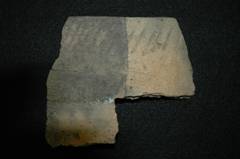 Archaeological evidence indicates that Chickahominy pottery of the Late Woodland period was more highly decorated than that of other groups within the Tidewater region. These shards from a Chickahominy village site display a banded design across the rim. A cord wrapped stick was used to place the diagonal impressions along the neck area. Photo courtesy of Dept. of Anthropology, College of William & Mary.
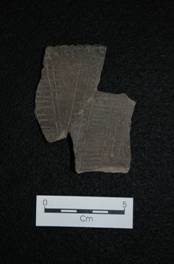 Some Chickahominy vessels show elaborate designs, scored along the rim in the neck region of the pot. These Designs may indicate specialty use of the pottery for feasts or provide information about aesthetics. Similar designs were used in women’s tattoos. Photo courtesy of Dept. of Anthropology, College of William & Mary.
 Designs appearing directly on top of the lip of pottery are called crenellations . Drawing (not to scale) courtesy of Jenn Ogborne.
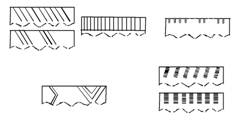 The Chickahominy utilized different design styles. Most designs were created by incising or impressing the moist clay with plain or cordage wrapped sticks. Drawing (not to scale) courtesy of Jenn Ogborne.
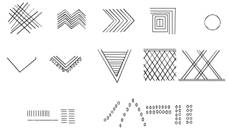 Other designs were created by using a small hollow reed to impress the moist clay along the neck region of the unfired pottery. Impressions of this type are called punctate designs. Drawing (not to scale) courtesy of Jenn Ogborne.
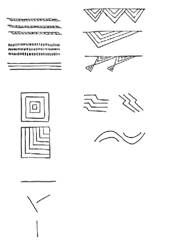 Most Chickahominy designs were created by scraping lines and inscribing bands of chevrons into leather-hard clay. Drawing (not to scale) courtesy of Jenn Ogborne.
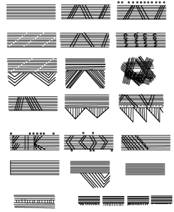 Groups of concentric squares, enclosed chevrons, and multiple bands are among the designs found along the neck area of Chickahominy pottery. Drawing (not to scale) courtesy of Jenn Ogborne.
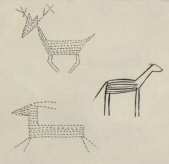 Decorations,
such as these, found on Colono pipes may exhibit both African and Indian designs.
Mouer, L. Daniel, "Chesapeake Creoles: The Creation of Folk Culture in Colonial
Virginia," fig. 4 in Reinhart, Theodore R. and Pogue, Dennis J., eds. The Archeology
of 17th Century Virginia. Courtesy Archaeology Society of Virginia.
Decorations,
such as these, found on Colono pipes may exhibit both African and Indian designs.
Mouer, L. Daniel, "Chesapeake Creoles: The Creation of Folk Culture in Colonial
Virginia," fig. 4 in Reinhart, Theodore R. and Pogue, Dennis J., eds. The Archeology
of 17th Century Virginia. Courtesy Archaeology Society of Virginia.
next Key Events