ca.1560
A Spanish ship visited the Virginia/Carolina
area and captured a young Virginia Algonquian named Paquinquineo
who was away from his homeland (the mouth of the Chickahominy)
visiting to the south. The boy, possibly a Paspahegh, was
taken to the Spanish controlled Caribbean, Mexico, and Spain,
baptized and given the Christian name Don Luis de Velasco.
Later, Don Luis returned to the Chesapeake as a guide for
a group of Spanish missionaries.
ca. 1565-1600
European diseases ravaged the coastal region
of Virginia and Carolina. Populations of Algonquian speakers
were weakened. Groups moved to accommodate lost population
and to strengthen their communities.
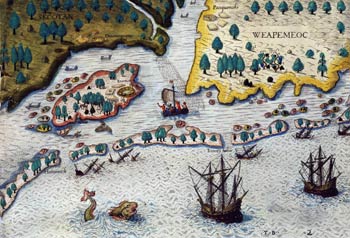
Harriott, Thomas. A briefe and true report of the new found land of Virginia, with engravings after John White. Published by Theodore de Bry. Frankfurt-am-Main,1590. Courtesy The Mariners' Museum, Newport News, VA. |
 |
1570
The Spanish established a mission on the York River within the Chiskiack territory. Don Luis (the Paspahegh captive) led the missionaries to this area. Don Luis soon returned to his natal town in the Paspahegh territory.
1571 (February)
The Spaniards were killed, and the
mission was destroyed and looted by the neighboring tribes,
including the Chickahominy, Chiskiack, Paspahegh.
1571 (late Spring)
A Spanish supply ship arrived in the
Chesapeake seeking to discover the fate of the Jesuits. A
skirmish ensued between the Natives and the Spanish near
the old Mission. Several Indians were captured. The ship
returned to Cuba.
1572 (Summer)
Spanish war ships entered the Chesapeake.
Conflict erupted. Many Indians were captured or killed in
multiple incidents from the Chickahominy territory to Kecoughtan.
One Spanish survivor of the mission was rescued, a young
boy spared during the raid. The ship returned to the Caribbean
with dead Indians hanging from the masts. The Chickahominies
were reported to have remembered the Spanish with hatred
for years to come.
ca. 1565-1575
Paramount chief Powhatan rose to hereditary power
over the districts of Powhatan, Arrohateck, Appamattuck,
Pamunkey, Mattaponi, and Youghtanund. He began to expand
his territory over the coastal plain through trade, intimidation,
and force, eventually obtaining a controlling influence over
all Eastern Virginia Algonquian speaking tribes except for
the Chickahominy.
ca. 1584-1585
English colonists settled at Roanoke Island,
North Carolina. Over the next few years, they visited and
attacked various groups in the Albemarle, Currituck and Chesapeake
drainages. Several Englishmen were left behind when the colony
failed. Later, fifteen more colonists were left by a supply
ship at the island. The first ‘Lost Colonists’ whereabouts
were unaccounted for. Word of the English settlement traveled
throughout the Algonquian speaking world.
ca.1587
A second English settlement was attempted at Roanoke
Island, with plans to reach the Chesapeake Bay. This group
of ‘Lost Colonists’ also eventually dispersed
into the Virginia/Carolina interior. Some descendants of
these colonists were later reported to be living among the
James River Native groups.
1588
Spanish ships sailed into the Chesapeake Bay and
abducted Natives from the Northern Neck and the Eastern Shore.
ca.1595
Powhatan invaded Kecoughtan and seized control
over this formerly separate polity, leaving the Chickahominy
as the only independent group within the James and York River
drainages.
1602
Voyagers from England investigated the Chesapeake
Bay.
1603
Europeans returned to the Chesapeake Bay. During
one brief stay, local tribes attacked the Europeans.
ca.1605
Europeans visited coastal Virginia and an exchange
took place at Rappahannock. Some trading occurred, but
the Rappahannock Chief was killed and others were taken
prisoner. Word of the European visits traveled to all
Algonquian speaking communities, including the Chickahominies,
Paspaheghs,
and Weyanocks.
ca.1606
Powhatan attacked the Chesapeake Indians in present
day Tidewater. Many groups participated in the raid, possibly
including the Chickahominies and Paspaheghs. The Chickahominies
were known to have been paid in copper to fight for Powhatan.
At the very least, word of the attack traveled to the Chickahominy,
Paspahegh, and Weyanock tribes. Surviving Chesapeake women
and children were dispersed into other tribes.
April 1607
The London Company ships – the Susan
Constant, the Godspeed and the Discovery entered the Chesapeake
and began searching for a place to build a fort, eventually
selecting Jamestown Island in Paspahegh.
1607 (May 21-27)
The English conducted
an exploratory trip up the James River and visited Powhatan,
Arrohateck,
Appamattuck, and Weyanock. Returning to the Fort the voyagers
learned that an attack had taken place in their absence.
Scattered attacks on the Fort by local Indians including
the Appamattucks, Chickahominies, Chiskiacks, Paspaheghs,
Quiyoughcohannocks and Weyanocks continued. However, by mid-summer,
the Quiyoughcohannocks had made peace with the English and
were trading corn for English goods.
1607 (Fall)
The English sought to trade with the
Paspaheghs for corn, but only succeeded in obtaining ten
bushels. Paspahegh warriors attempted to coerce the English
into giving up their weapons, and alternatively sought to
entice them with the promise of trade upriver. The English
returned to Jamestown, leery of Paspahegh intentions.
November 9-11, 1607
John Smith conducted his first voyages
up the
Chickahominy River during which time he successfully traded
with the Chickahominies for hundreds of barrels of corn – enough
to feed the Jamestown settlers through the winter.
December 10, 1607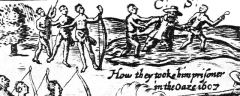
Smith again visited the Chickahominies
to trade for corn, but also because he was interested in
exploring the river. Traveling in a canoe with two Chickahominy
guides Smith was captured about 20 miles above the last Chickahominy
town by Opecancanough and a large hunting party comprised
of hunters from a number of different tribes. Smith spent
a month in captivity before he was released and returned
to Jamestown.
1608 (April)
After arrival of the English the Paspaheghs
began acquiring English tools by whatever means they could
and began getting captured as a result. Powhatan was informed
that the English had captured 16 to 18 Paspaheghs. In retaliation,
the Paspaheghs captured several Englishmen, hoping for
an exchange. The English, led by John Smith, attacked and
burned a Paspahegh village, and the English were released.
Amocis, a Paspahegh, was at that time living within the
Fort. At Smith’s request, a Weyanock Weroance was
sent to Jamestown as an upriver guide. Soon Amocis and
the Weroance slipped out of the Fort; however, Powhatan
soon executed Amocis for his treason in dealings with
the English. A delegation including Pocahontas arrived
from Werowocomoco to negotiate for release of the prisoners.
After some negotiation, the prisoners were released, and
the party retired to Paspahegh. By this time political
and social interactions had revealed to the Native populations
that the English were not just visiting temporarily, but
had serious intentions in the region. Powhatan’s
intention to control the English presence, trade and alliances
had also become apparent to the English.
1608
Piankatank was attacked by Powhatan. The Weroance,
women, and children were delivered to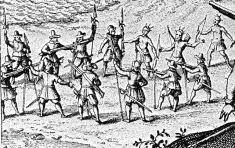 him
and resettled among other territories.
him
and resettled among other territories.
Portions of
the remnant Kecoughtans were removed and settled at Piankatank.
While not directly
mentioned in the historical literature, the Chickahominies
were surely affected in some way by these actions.
As an
independent polity and hired warriors, continuing Powhatan
expansion into other territories must have threatened
Chickahominy independence and security.
1608 (Fall)
Smith and 18 men visited the Chickahominies
seeking to trade goods for food. Villagers declined to trade
because the corn crop had been poor that year. Smith threatened
revenge for his previous capture and the death of his men.
The Chickahominies fled, but several messengers were sent
back with fish, fowl, and corn to make peace. The English
loaded two boats with corn and left after staying four or
five days in the territory. The Weyanocks also fled into
the forest with their corn. Their village was empty when
the English arrived. Other groups, such as the Nansemond
and the Appamattucks, were forced to trade for corn.
ca. 1609-1612
The Chickahominies were described during
this time period by William Strachey as being “warlike
and free,” with 300 warriors at their disposal. Strachey
reported that they observed several obligations to Powhatan
for which he paid them in copper. They did not allow any
Weroance to govern them, but preferred to be guided by their
priests and elders - Cawcawassaughes.
1609 (January / February)
Powhatan moved his capital
from Werowocomoco to Orapax at the head of the Chickahominy
River.
1609 (Winter)
The Chickahominies traded meat with
Jamestown’s starving settlers for tools and ammunition.
1609 (Spring)
Wowinchapuncke attempted to ambush John
Smith, near Jamestown. The attack was botched, and Wowinchapuncke
was captured instead. He was held prisoner as ransom for
Germans living with Powhatan. Wowinchapuncke’s wives
and children visited the fort while awaiting a response from
Orapax. Eventually, Wowinchapuncke managed to escape captivity
with help from a party of Paspahegh warriors. In retaliation,
John Smith captured two Paspaheghs (Kemps and Tassore) and
enticed them with copper to betray their Chief. Kemps and
Tassore guided an English attack on Paspahegh that resulted
in burning of Wowinchapuncke’s home and the dispersal
of his villagers. Smith returned and burned more houses.
He also killed several Paspahegh and destroyed fishing weirs.
Smith moved up river as he was enticed to fight by Paspaheghs
along the banks. However, peace was negotiated and hostilities
ceased until the corn became ripe. The Paspaheghs promised
to deliver food to the Fort.
1609 (Summer)
Several Chickahominies stole tools
and firearms from Jamestown. One was captured and held as
ransom for return of the materials, but died in captivity.
Some Englishmen abandoned James Fort, choosing to living
with the Natives. Kemps, the Paspahegh Indian, returned some
English men who were living with the Paspahegh. By 1612 reports
circulated in European circles that English men had gone
to live with the Natives and had taken Indian wives.
1609-1613
English - Native relations during this
time period were characterized by alternating periods of
peace and conflict. Englishmen were
often attacked while outside the Fort’s perimeter. Some English were captured
by Powhatans. Others run away to stay with Native communities.
Some Indians took up residence in the Fort, including women.
1610
A Paspahegh man was captured, mutilated and
sent to Powhatan as a warning to return 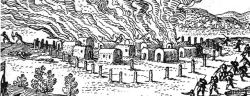 harbored Englishmen,
or have villages attacked and fields burned. The Paspaheghs
were attacked in August of 1610. The Chief’s Town was
burned, crops cut, and 15 villagers were killed. Wowinchapuncke’s
family was carried off. The children were thrown into the
river and shot in the head. Later, back at the Fort Wowinchapunck’s
wife was killed by sword. Fleeing tribal members took refuge
with neighboring tribes. Wowinchapuncke escaped unharmed.
harbored Englishmen,
or have villages attacked and fields burned. The Paspaheghs
were attacked in August of 1610. The Chief’s Town was
burned, crops cut, and 15 villagers were killed. Wowinchapuncke’s
family was carried off. The children were thrown into the
river and shot in the head. Later, back at the Fort Wowinchapunck’s
wife was killed by sword. Fleeing tribal members took refuge
with neighboring tribes. Wowinchapuncke escaped unharmed.
1611 (February 11)
Wowinchapuncke and a band of
warriors staged an ambush at the entrance to Jamestown Island.
During the fighting, Wowinchapuncke was mortally wounded.
As Paspahegh warriors sought to retrieve his body a Paspahegh
Councilor also was killed. Several days later the Paspaheghs
killed a number of English.
1611 (May)
By May the surviving Paspaheghs had disappeared
from their territory. They took refuge with the other communities
neighboring their former district.
1611-1616
English settlements were planted at Henrico,
Bermuda, Kecoughtan, and the Eastern Shore. These settlements
represented encroachments into the territories of the Accomacks,
Appomattoxs, Arrohatecks, Kecoughtans, Powhatans and Weyanocks.
1613
English planters settled West and Shirley Hundred
in the immediate vicinity of the Weyanock Chief’s town
and two other Weyanock villages.
1614
The Virginia Company approved the further privatization
of land. Previously 100 acres had been granted to each “ancient
planter,” meaning a settler who had resided in the
colony for three years. Now each person who paid for his
own passage might receive 50 acres and investors could purchase
the same. By 1619, indentured servants were granted land
for completion of their service. Trade continued to be important.
Corn became a commodity during this period, meaning that
the English began to establish specified values for corn
in relation to other goods, and Indian corn began to be accepted
as payment in local courts at this time.
Spring 1614
Chickahominy entered into a separate
Treaty with Sir Thomas Dale, promising to pay tribute annually
in corn and to help the English fight against their enemies.
1615
Ralph Hamor wrote that the Chickahominies were a
daring people and free from Powhatan’s subjection,
having laws and governors within themselves. They previously
had paid tribute to Powhatan, but now had refused and were
acting independently. The corn harvest was poor that year
for the Chickahominies.
1616
George Yeardley, now the President of James Fort
sent for the Chickahominy tribute of corn, only to receive
a poor response. Yeardley assembled 100 men and invaded the
territory. The Chickahominies refused to pay tribute to Yeardley
in Dale’s place taunting the party to come ashore at
the village of Ozinies to fight. After some posturing the
English continued upriver and marched towards Mamanahunt.
Led by Kissanacomen, leader of Ozinies, the Chickahominies
followed and taunted the English. In the night, the Chickahomy
of Ozinies crossed the river while the English made plans
to attack Mamanahunt. The next day the English followed the
Ozinies war party across the river searching for newly harvested
corn that had been well hidden in the woods. Yeardley ordered
the English to prepare to fight and to take prisoners. Shots
were fired killing or maiming 12 Chickahominies 12 more were
captured; among those captured were two brothers who were
Chickahominy Councilors. The Chickahominies paid one hundred
bushels of corn for their ransom.
Opechancanough plotted to subjugate the Chickahominies. Knowing that Powhatan
had never been able to make them fully compliant, he informed Yeardley that
he would confer with him before he making peace with the Chickahominies. Arriving
at Ozinies with prisoners, the English meet Opechancanough who had arranged
another truce that established him as the new “King of Ozinies.” The
Chickahominies offered beads, copper, and other goods as tribute to Opechancanough.
The English marched to James Fort with three boats loaded with corn and other
provisions. The Chickahominies and the Powhatans were united through Opechancanough’s
efforts.
1617 (Spring)
Powhatan died, and Itoyatin became
the new paramount chief, or Mamanatowick, at least as to
groups still willing to recognize the political arrangements.
Groups farther away from the 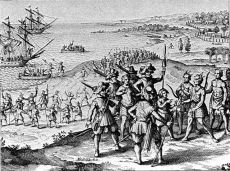 James/York districts had grown
more independent in their actions. Other groups, such as
the Paspaheghs, had dispersed and joined (consolidated with)
other tribes.
James/York districts had grown
more independent in their actions. Other groups, such as
the Paspaheghs, had dispersed and joined (consolidated with)
other tribes.
1617
Opechancanough presented Sir George Yeardley with
a sizable tract of land, described as 2,200 acres. The gift
was taken from Weyanock territory.
1617
Jamestown focused on tobacco production. Native
people were found within the settlement as frequently as
the English. This probably included the Chickahominies due
to their established relation with the English and their
proximity to the Fort.
1617
Smyth’s/Southampton Hundred were established
at Dancing Point in the former Paspahegh territory.
ca.1618
Tanks Weyanock was settled by English planters
under George Yeardley, using the grant made by Opechancanough
of properties known as Weyanock and Konwan.
1619
The Great Charter was written by the London
Company in 1618 and brought to Virginia by Yeardley when
he in returned in 1619. The Charter established four boroughs
or incorporations and established their boundaries: James
City, Charles City, Kecoughtan, and Henrico. Yeardley was
later criticized by several of his countrymen and subjects
for the Indian land negotiations and his self-interested
advancement of personal interests. Natives no longer possessed
the Kecoughtan and Paspahegh districts. Appamattuck, Weyanock,
Arrohatec, Warraskoyac, and Powhatan were fighting off English
expansion on both sides of the James River. The Weyanocks
had moved the majority of their settlements on the south
of their former territory.
1619 (Summer)
A band of Chickahominies killed English
traders for their goods and as revenge for the 1616 killings.
Additionally, they raided their own temple and charnel house
for prestige goods and fled the area. The following Sunday,
the band attacked an English settlement and killed several
people, including three children. Opechancanough declared
that he would not break the peace and vowed to deliver the
band’s Chickahominy town to the English and to send
the heads of the renegades to Jamestown. Eventually the renegades
made peace with Opechancanough and the Chickahominy town
remained an Indian district.
1619
(August)
Regulations were instituted to govern
trade. While trading with Indians was allowed, this did not
include Indian servants. No arms, powder, shot, large hoes
or large canines (greyhounds, mastiffs) were to be traded
or given to Indians. All Englishmen were required to obtain
a passes from the Governor before visiting Indian towns.
Theft of Native canoes was made subject to the penalty for
larceny. Trade on the Chesapeake Bay was forbidden.
1619
Westover was settled by English planters in
Weyanock territory.
ca.1619
Berkley Town and Hundred was settled by
English planters under the guidance of Richard Berkley, William
Throckmorton, George Yeardley, George Thorpe and John Smyth.
This Hundred, too, was located in the heart of Weyanock territory.
ca.1620
Swinhow’s, a 300-acre settlement,
was planted by George Swinhow in Weyanock territory, presumably
in the vicinity of Swineyards Landing.
ca.1620
Causey’s Cleare or Care was settled
by Jamestown veteran Nathaniel Causey who obtained a grant
for 200 acres in December of 1620. The settlement was located
at Epps Island, also in the heart of Weyanock territory
1621
Opechancanough took the name ‘Mangopeesomon’ and
Itoyatan took the name ‘Sawsapen.’ These changed
names probably reflected personal preparations for the ensuing
Great Assault. During the summer, Opechancanough also was
reported to have sought a supply of poison from Eastern Shore
Weroances, possibly for use in the planned assault.
ca.1621
Chickahominy warriors involved in the attacks
of 1619 attempted to inflict harm on Esmy Shichans of Accomack.
A quarrel between Opechancanough and ‘the Laughing
King’ had erupted, possibly related to the acquisition
of the poison. The Chickahominy were discovered before the
plan could be completed and retreated to Smith’s Island,
where they attacked English livestock. Afterwards the band
settled between the Nansemond and Chesapeake territory under
the direction of Itoyatin. Increasingly, the Chickahominies
became targets of English retribution.
1622 (March 22)
English settlements were attacked
in a carefully planned and coordinated assault. Nearly 25
settlements were surprised, resulting
in death of approximately one quarter of the English population.
All seven English
plantations within modern day Charles City County were attacked
and a total of 50 settlers or more were slain. West and Shirley
Hundred (later known as ‘Shirley’) and Southampton
Hundred were the only settlements that appear to have been
maintained through the summer after the assault.
1622 (Summer)
The English raided the Appamattucks
and Weyanocks. The Nansemonds retreated into the woods with
their late corn crop, abandoning their village. At Pamunkey,
the English demanded the return of prisoners. The Chickahominies
retreated in the face of an English raid, losing houses,
weirs, and crops. All remaining James River Native communities
suffered similarly during this time.
1623
By January of 1623 the English had counterattacked
the Nansemonds, Warraskoyacks, Quiyoughcohannocks, Weyanocks,
Powhatans, Pamunkeys and Chickahominies.
July 23, 1623
Capt. William Pierce was dispatched against
the Chickahominies and Capt. William West was ordered to
go against the Weyanocks. Many Natives were slain, their
towns burnt, weirs and crops destroyed. These late summer
attacks were designed to come at a time when it was too
late to replant crops and thus to destroy Native food stores.
Additionally, the English hoped to disrupt trade between
groups, effectively diminishing their ability to obtain
sustenance.
Complete extermination was not the objective, as the English
retained an interest in converting Indians to Christianity
and in retaining them as servants. The Chickahominies felt
the intensity of the attacks and moved farther up the Chickahominy
River. Soon English planters would settle the mouth of
the Chickahominy River.
1624
Trade with Indians for corn was prohibited
by the General Assembly. Every house was ordered to be paled
for defense against Indians. Englishmen were instructed not
to travel or work in the field without arms and companions.
Each incorporation of the English Colony also was instructed
to attack neighboring Indians each July, as had become tradition
following the 1622 Great Assault. Contact with Natives by
outlying English settlements was forbidden. Conflict between
English and Indians was temporarily reduced to sniping and
destruction of property.
1625
Hostilities declined and raiding, prisoner
taking, and sniping constituted the primary incidents occurring
through 1629.
1626
A Weyanock man was captured at Berkley Hundred
and sent to the Eastern Shore in service.
is captor was
granted permission to take the man to England.
1627 (August)
English raids occurred
at Powhatan, Pamunkey, Weyanock, Chickahominy, Quiyoughcohannock,
Warraskoyack, Nansemond, and Chesapeake
1628
A Treaty was established, presumably having
terms similar to those of previous agreements. Surviving
records mention only that no Indians were to approach English
settlements except upon official business and that no livestock
or travelers in the woods would be harmed.
1629 (January)
The Treaty was broken off and raiding
and sniping resumed.
1630
Indians were contracted to serve within English
settlements as domestic servants. Indian parents continued
to be solicited for placing their children in English homes
to be reared in European ways. Weyanocks and Chickahominy
participated in a variety of labors for Englishmen and
sent their children to the settlements.
1632
Drought decimated the territory of Eastern
Virginia. Crops were particularly hard hit, limiting English
and Indian maneuverability. Laws were passed within the General
Assembly forbidding attacks on Indians absent specific provocation.
September 30, 1632
Peace treaties
were settled with the Chickahominy and Pamunkey, although
a proclamation issued
that settlers were “not to parley with or trust them.”
1633-42
Laws and regulations pertaining to the Indian trade
were enacted and revised within the General Assembly, especially
related to trade of firearms. Continuing English expansion
into Indian territories created renewed unrest.
1633
The General Assembly enacted a law prohibiting
trade with Indians for cloth or other English trade goods
because of a shortage of such goods for English who needed
them.
1634
Counties were established for the English settlements;
large palisades divided the ‘English Controlled’ areas
from the ‘Indian’ areas, effectively serving
as a boundary to limit the Indian movement into colonial
districts and protecting European livestock from poaching.
The Chickahominy farther removed to the northern portion
of the Chickahominy River. The English continued to settle
the Chickahominy area, allotting it to “young freemen” in
1637, presumably because of its remoteness. One town remaining
on the lower Chickahominy, Ozinies (Warreny), was surrounded
by squatters by 1638.
1643
A General Order was issued by the district
court prohibiting all trading with the Indians except by
those so commissioned.
1644 (April 18)
English settlements were attacked
by Powhatans along the heads of the rivers, and the Southside
of the James in a Second Great Assault. Weyanocks, Appamattucks,
Chickahominy, Nansemonds, Pamunkeys, Mattaponies, Chiskiacks,
and some Rappahannock river tribes attacked English plantations,
killing and capturing many. More than 500 settlers lost their
lives – many more than in the 1622 Assault – but
the colony was sufficiently well established by this time
that its survival was not threatened by the attack.
1644 (Summer)
The English attacked Powhatan districts.
Trade between the colonials and Indians was forbidden and
plans for additional retaliation were discussed within the
General Assembly. Pamunkey, Chickahominy, and Weyanock villages
were especially hard hit. Some bands retreated into the dense
forest. A public levy on tobacco was enacted to cover expenses
incurred for the “Pamunkey and Chickahominy marches.”
1644
Forts were constructed at the fall line of the James
(Fort Charles), and on the Chickahominy (Fort James), Pamunkey
(Fort Royal) and Appomattox Rivers (Fort Henry). Fort James
was constructed in New Kent County on “the Ridge of
the Chickahominy,” presumably meaning high bluffs overlooking
the river at the head of Turner’s Neck. After three
years Fort James was transferred to Thomas Rolfe, son of
Pocahontas.
ca. 1644
Weyanocks and a band of Nansemonds fled
south of the James River districts. The Weyanocks settled
along the Roanoke River in modern day North Carolina. Opechancanough
sent messengers to retrieve the groups. The Weyanocks killed
the runners.
1645
Raiding and sniping continued. In July the
English attacked Ozinies (Warreny), and the remaining Chickahominies
fled north towards the Mattaponi River or took refuge at
Pamunkey Neck.
1646 (March)
Opechancanough was captured by the
English and shot in the back by a prison guard at Jamestown.
1646 (October)
Necotowance, the new leader of the
Powhatan, negotiated a treaty with the English which established
separate zones for the English and the Natives, thus pushing
the Indians out of the area between the James and York Rivers
and between the James and the Blackwater River.
1646
The Chickahominies removed to the north side
of the Pamunkey River, above the Pamunkey and the English
Fort Royal (near the modern-day City of West Point). There
they banded with the Pamunkeys in occupying the peninsula
known as Pamunkey Neck. English squatters were ordered off
tribal lands in 1653 and 1658.
1647
Necotowance and messengers of local tribes
were permitted to report to Capt. Edward Hill at Westover
and Capt. William Taylor at Chiskiack in addition to the
other locations approved for the entrance of Indians into
the English 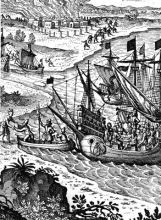 zones. A pathway running from the Chickahominy
River to the James was named ‘Necotowance’s Path’ (later
anglicized to Nicodemus) presumably because it was the authorized
passageway for messengers crossing Charles City County. The
trail appears to have been a pre-existing Native pathway
that connected to Rickahoc Path which transected New Kent
County between the Chickahominy and the Pamunkey Rivers.
zones. A pathway running from the Chickahominy
River to the James was named ‘Necotowance’s Path’ (later
anglicized to Nicodemus) presumably because it was the authorized
passageway for messengers crossing Charles City County. The
trail appears to have been a pre-existing Native pathway
that connected to Rickahoc Path which transected New Kent
County between the Chickahominy and the Pamunkey Rivers.
ca.1650
The Weyanocks, who had previously moved away
from the James River drainage, settled in Hertford County,
North Carolina, near Wiconnes Creek. Their settlements were
named Cotchawesco and Auhotsky.
ca.1650
The English continued to move into Indian
lands. Three Powhatan Chiefs Totopottomoy (Pamunkey), Ascomowett
(Weyanock), and Ossakican (Northern tribes) were granted
land patents, in an effort to convert Powhatans to individual
land ownership practices. Other Weroances were to be given
land patents at a rate of 50 acres per bowman. The English
also continued attempts to instill Christian principles and
other European values in Native communities.
1653
Weyanocks fled North Carolina after conflict with
the Tuscaroras and settled on the Nottoway River near Courtland,
Virginia. The town was known as Warekeck, other dispersed
Weyanocks lived around Assamoosick Swamp.
1655-9
Indians appeared in Charles City Court to
receive bounties for hunting wolves and to be documented
as servants and as guides. Westover served as the local for
confirmations of Indian service.
1656
By the 1650’s Chickahominies had returned
to the earlier government of a council of leaders, and were
referred to in the records as separate from other Powhatan
groups. The Pamunkeys and Chickahominies were at this time
the largest tribes within the colony’s bounds. A combined
force of Englishmen commanded by Edward Hill and Pamunkey
warriors led by Totopottomoy were defeated by enemy Indians
at the Falls of the James. While consulted about the foreign
Indians prior to the attack, the Chickahominies do not appear
to have participated in the fight. At the death of Totopottomoy,
his wife Cockacoeske became leader of the Pamunkey. In ensuing
years, conflicts erupted over whether Cockacoeske indeed
spoke as leader for all Powhatans, or just the Pamunkey.
The primary complaints came from the Chickahominies and Rappahannocks.
1659
The government encouraged all able men to trade
with neighboring Indians for skins. Sale of firearm and powder
was made legal. John Beauchamp was authorized to take an
Indian boy to England, but only if the Charles City Court
found evidence that his parents consented.
1660
Virginia established a licensing system for “trucking,” that
is trading, with Indians. At this time, Harquip was the Mangui
(headman or orator) of the Chickahominy Council.
ca.1660
The General Assembly continued efforts to
regulate Indian trade and firearm possession. Land purchases
from Indians without governmental permission were prohibited,
and unregistered Indians were forbidden to remain within
the colonial boundaries. Conflict continued to erupt due
to rampant abuse of the agreements. The English continued
to view the Powhatans as critical buffers protecting them
from foreign Indians.
1660
Weyanocks became indebted from trade with English.
In 1659 the Weroance of the tribe, Ascomowatt, assumed the
debt for the community and applied for “safe passage
and relief” in order to pay the debts. Previously imprisoned
for debt, he now tried to resolve to problems with the creditors.
1661
The Chickahominies left the Pamunkey River
area and established a new settlement for themselves at the
headwaters of the Mattaponi River near modern day Aylett.
They held this land until 1702. The Charles City Court revoked
licenses to keep Indians in domestic service. However, the
decree apparently did not stand. Indians continued to be
listed in service in the English boroughs as slaves and servants.
1662
The Weyanock Weroance sold a Powhatan boy to
a Surry County woman as a slave. The sale was deemed fraudulent
and overturned by the General Assembly.
1661(2)
The Weyanock settlement of Warekeck was
attacked by Nansemonds and the Weyanock Weroance was killed.
The Weyanocks appealed to English for protection. They stayed
with the English for two years within the Blackwater Boundary.
1662-63
Conflicts between Indian servants and their
English masters occasionally resulted in judicial proceedings.
On one occasion, an Indian servant to Capt. John Wall named
Elizabeth Christiana was charged with biting, punching, and
sticking her mistress’s head in an oven. Elizabeth
was found guilty of “violent and insolent resistence” and
was ordered to serve an additional term of years. On another
occasion Indian Thomas, a servant to Rice Hoe, sued for his
illegal detention. The court ruled for Thomas and ordered
Hoe to release him and supply him with two good new canvas
shirts and one pair of canvas drawers, the goods due an indentured
servant and the end of his term.
1664
The Weyanocks returned to Warekeck. Soon the Weyanock
attacked the Nansemond in revenge, killing their Weroance
and then returned to Cotchawesco and Auhotsky in North Carolina,
fearing Nansemond reprisal (and having then to contend with
Tuscaroras).
1665
Dutch were defeated. A firearms act strictly
regulated trade with Indians.
1667
The Weyanocks guided English traders into Meherrin
territory and visited upriver towns.
1667
The Meherrin abandoned the village of Unote, and
the Weyanocks moved to settle on the Meherrin River, taking
up the old locale until ca.1670. Tuscarora attacks continued
against the Weyanocks. Again the Weyanocks sought asylum
with the English.
1669
The Chickahominies were recorded as having 60 bowmen
or a total population near 240 persons. John Lederer departed
for western exploration from the Chickahominy settlement
on the upper Mattiponi River.
ca.1670
The Weyanocks settled Musketank in modern Surry
County near Otter Dam Swamp (south side of Blackwater River,
slightly west of Waverly, Virginia). The Tuscaroras claimed
this land, and the Weyanocks had to purchase it from them.
The group later (1676) moved deeper into the swamp at the
outbreak of hostilities during Bacon’s Rebellion.
1675
The English Interpreter for the Chickahominy
was ordered to restore the Mangui to his rightful post
1676
Nathaniel Bacon, acting as a leader of rebellious
colonials, began attacking Indian communities and seizing
property from both Indians and pro-government Englishmen
alike. Considerable conflict erupted at Appomattox, Occaneechi,
and Pamunkey. Other Indian groups also were affected by the
hostilities.
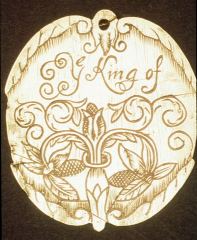 |
Photo courtesy Virginia Dept. of Historic Resources. |
1677
In May of 1677 the first Treaty of Middle Plantation
was signed by Virginia and some of the Indian groups affected
by Bacon’s Rebellion. Cockacoeske of Pamunkey signed
not only for her community, but also for the Rappahannock
and the Chickahominy. Those groups protested over the Pamunkey
subjection prescribed by the peace accord, and appear to
have maintained their independence. Original signers included
the Pamunkeys, the Weyanocks, the Nansemonds, and the Nottoways.
1680
Further negotiations resulted in an appendix
to the 1677 agreement. The second Treaty of Middle Plantation
was signed by the Meherrins, the Sapponies, the Appomattox,
the Monacans, and the Nanzaticos / Nansemonds / Portabacos.
1681
Nottoways and Meherrins attacked a band of Weyanocks
on the Black River near Waverly, Virginia. The Weyanocks
appealed to the English for protection.
1683
Senecas attacked Virginia settlements including
the Mattaponi and the Chickahominy. The Mattaponi and Chickahominy
took refuge with the Pamunkey, but relations between the
groups were strained. Land leases, sales, and conflicts over
tribute and interpreters again left the Chickahominies eventually
going their own way. They petitioned the Governor for land
and continued to be entangled in land controversy into the
18th century.
1685
Pamunkey, Mattaponi, and Chickahominy leaders
attended a British - Iroquoian Peace Council in Albany, New
York.
1688-1694
Charles City Court records document 32
Indian children between the ages of 4 and 12 years old who
were brought into court to have their ages determined. Most
likely these children were captured in hostilities outside
of the region, but might have been from local tribes.
1689
The Chickahominies and various other tribes
asked Lord Effingham for protection from Indian raids.
1691
Chickahominies living on the land of Ben Arnold
petitioned to be allowed to stay on the property.
1692
Counties were ordered to establish trading
locations for Indians. Free trade with Indians was established,
that is, no longer reserved exclusively to licensed traders.
Indian hogs were to be marked in a manner distinctive to
each tribe to prevent confusion and theft in the sale of
pork to the English. Surry County was ordered to assign
marks for the Weyanocks and the Nottoways.
1693
The Weyanocks sought permission to slaughter
hogs under an older mark than the one recently established
for them. The Weyanocks abandoned their settlement and the
group dispersed to live with the Nansemonds and the Nottoways.
1699
Thomas Story, a Quaker missionary, visited the Chickahominies
at their settlement on the headwaters of the Mattaponi River.
Story described the Chickahominy as living on the north side
of the River, housed in 11 communal wigwams with bark coverings.
Members of the tribe spoke some English and engaged in conversation
with Story through two untrustworthy English interpreters
who were determined to make sport of the occasion. Story
spoke to their leader whom he called a Sagamor and whom he
described as a grave, serious and wary old man. The leader
probably was Drammacho. Story tried to discuss faith and
morality, but was misquoted by the interpreters. In particular,
Story commented about the pernicious influence English liquor
had had upon the Natives. Of the old leader, however, Story
said that it was reported that he shunned alcohol.
1699
The Chickahominy Mangui Drammacho petitioned
the General Assembly to acknowledge Pamunkey Neck as belonging
to the Chickahominies under the Articles of Peace (1677).
The Chickahominies said that their land did not produce very
well for them and they were interested 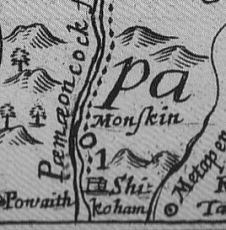 in relocating to “Quaynohamock” in
Pamunkey Neck. The Committee rejected the idea, stating that
only a three mile buffer around Indian towns was included
under the 1677 treaty and that all sales made by them are
null and void. Chickahominy exchanged lands held by the Crown’s
subjects were exempted from the action. The Pamunkeys and
Chickahominies continued arguing land claims into the 18th
century
in relocating to “Quaynohamock” in
Pamunkey Neck. The Committee rejected the idea, stating that
only a three mile buffer around Indian towns was included
under the 1677 treaty and that all sales made by them are
null and void. Chickahominy exchanged lands held by the Crown’s
subjects were exempted from the action. The Pamunkeys and
Chickahominies continued arguing land claims into the 18th
century
1700
Meherrin, Nottoway, Nansemond, Pamunkey, Chickahominy,
Rappahannock, and Nanzatico tribes attempted to broker peace
with the Northern Iroquois. Belts of peak were made in accordance
with tradition. The Virginia colonial government intervened,
however, to prevent the agreement in an effort to minimize
cooperation between subdued tribes and those still in open
conflict with the English.
1702
The Chickahominies lost their land on the Upper
Mattaponi and went to live with the Pamunkies.
next 1614 Treaty